
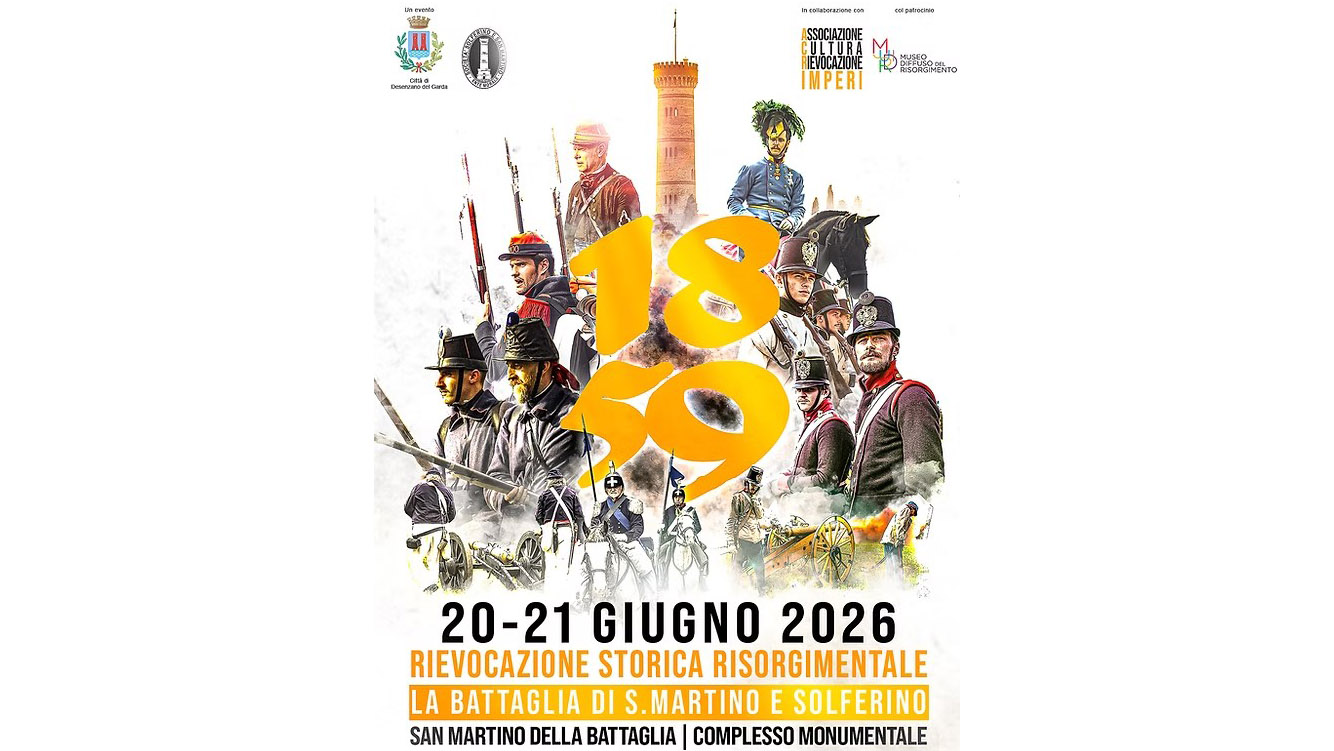
In the heart of the Italian Risorgimento, one of the most important chapters of 19th-century Europe comes back to life. The historical reenactment “1859”, organized by the Association for Culture and Historical Reenactment Imperi, takes visitors back to the days of the Battle of San Martino and Solferino, the historic clash of June 24, 1859 between the Austrian army and the Franco-Piedmontese troops led by Napoleon III and Victor Emmanuel II.
The event is not simply a spectacle of uniforms, horses, artillery and military maneuvers. It is above all a cultural and educational experience aimed at conveying the value of historical memory through the direct language of reenactment. The protagonists are historical reenactors, enthusiasts who dedicate years to studying uniforms, equipment, gestures, habits and even the mindset of the historical figures they portray.
As emphasized by the organizers, this is not just a “role-playing game”, but a true work of research and reconstruction that allows the public to approach history in an authentic and engaging way. An approach capable of fascinating both scholars and those discovering this historical period for the first time.
The event takes place in the evocative Parco del Laghetto in Desenzano del Garda, an area also easily accessible to people with disabilities, transformed for the occasion into a real 19th-century military camp. Here, visitors can watch reenacted battles, explore the camps, observe the activities of historical groups and fully immerse themselves in the atmosphere of the Risorgimento.
Great importance is also given to the human value of the event. In the acknowledgements published by the organizers, the spirit of collaboration behind the project clearly emerges: local administrations, volunteers, medical staff, historians, photographers and dozens of historical groups from across Italy all contribute to turning the reenactment into a major moment of cultural sharing.
“1859” is therefore much more than a simple historical reconstruction: it is a journey into Italy’s collective memory, an opportunity to reflect on the sacrifices and contradictions that accompanied the path toward Italian Unification, while keeping alive the connection between past and present through the passion of those dedicated to historical dissemination.


Campsites and Villages nearby
Subscribe to our newsletter for more offers!
Get information and exclusive offers with the ease of a click!